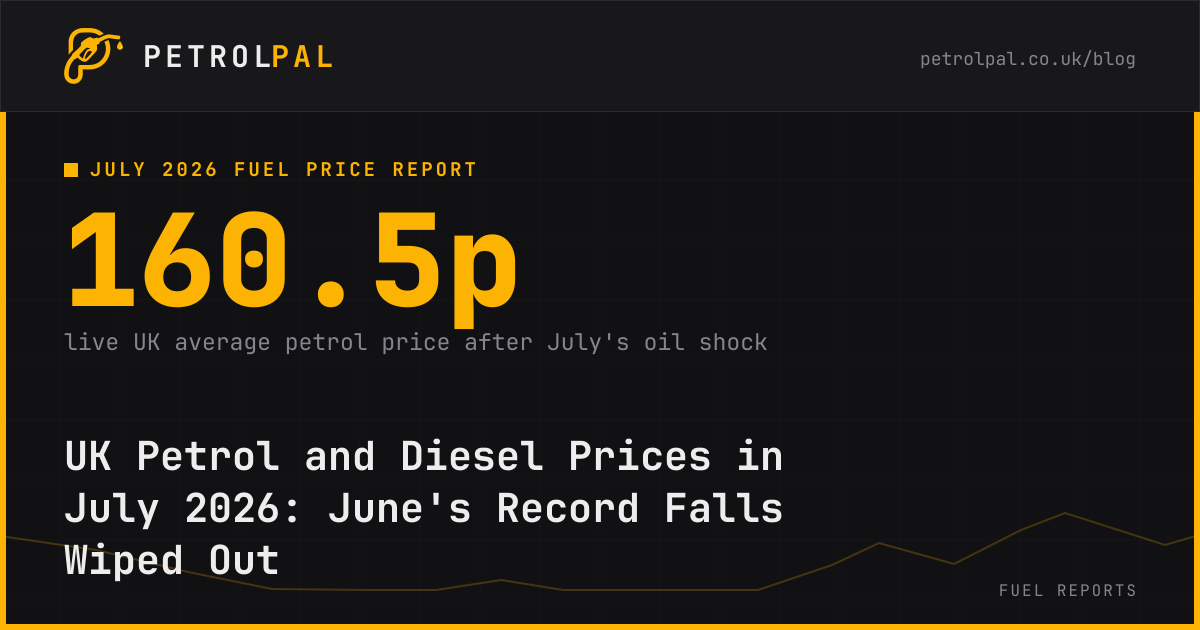
July 2026 was the month the pumps turned against drivers again. Live PetrolPal data across 8,027 UK forecourts shows unleaded petrol averaging 160.5p per litre and diesel averaging 180.6p per litre as of 2 August. On 1 July, petrol averaged 151.40p and diesel 167.14p (heycar). That is a rise of roughly 9p per litre for petrol and more than 13p for diesel in a single month, and almost all of it traces back to one thing: the confrontation between the United States and Iran around the Strait of Hormuz.
What Happened to UK Fuel Prices in July 2026?
June ended with genuinely good news. The RAC reported the biggest monthly diesel price drop on record, with diesel falling 17p per litre to around 167p and petrol down nearly 8p to about 151p (Bloomberg).
July took most of it back. Early in the month prices crept up slowly, with petrol rising slightly while diesel briefly edged lower in mid-July (IndexBox). Then the oil market moved, and the pumps followed. By late July, RAC Fuel Watch had petrol at 153.5p and diesel at 168.6p, with both up around 2p in a single week (GB News). PetrolPal's live all-station average has since pushed higher still, reaching 160.5p for petrol and 180.6p for diesel on 2 August.
A note on methodology: RAC Fuel Watch reports a weighted UK average, while PetrolPal's figure is a live mean across every station reporting to the government Fuel Finder scheme, including motorway services. The two will never match exactly, but the direction is identical: sharply up, and still rising.
Why Did Prices Jump? Iran, Trump and the Strait of Hormuz
The story of July's pump prices was written in the oil market, and the oil market spent the month watching warships. The key dates:
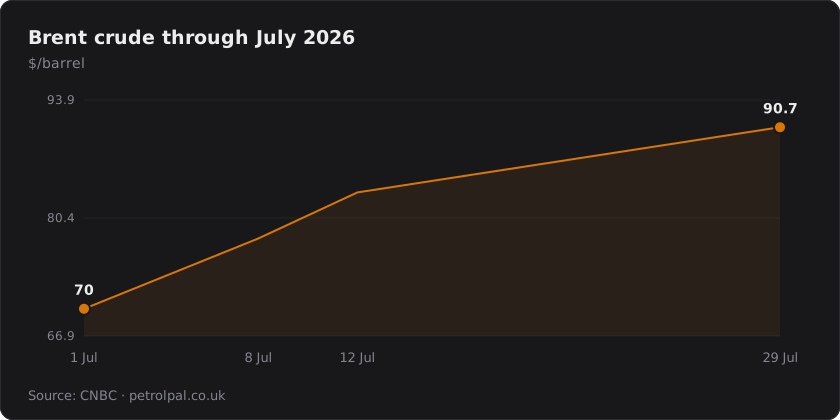
- 8 July: President Trump threatened to bomb Iran and reimpose a naval blockade after attacks on tankers in the Strait of Hormuz. Brent jumped 5.2% to $78.02 (CNBC)
- 12 July: The blockade was reinstated. Brent surged 9.6% in a day to $83.30, its biggest daily gain since May 2020 (CNBC)
- 14 July: US airstrikes on Iran began, and oil hit a one-month high as the outlook for Hormuz shipping darkened (Al Jazeera)
- 23 July: Attacks on Saudi tankers pushed prices up again (CNBC)
- 29 July: After further threats against Iran, Brent closed at $90.74, up 7.9% on the day (CNBC)
Roughly a fifth of the world's oil passes through the Strait of Hormuz, so any threat to that route gets priced in immediately. CNBC reported US strikes on Iran running for nine consecutive nights in retaliation for the tanker attacks, and analysts warned that a sustained slowdown in Hormuz shipping combined with depleted global inventories could push oil beyond $100 a barrel (CNBC).
By 31 July there was a partial reprieve: tanker flows through the strait began to recover, though the situation remained volatile as attention shifted to new US tariff threats against buyers of Iranian crude (CNBC).
How Fast Will Pump Prices Follow Oil?
Wholesale costs feed through to UK forecourts with a lag of one to two weeks, which is why pump prices were still climbing in early August even on days when crude eased. The RAC has warned that increases are likely to keep coming "thick and fast" as July's wholesale surge works through the system (GB News).
The uncomfortable half of that mechanism is that prices tend to rise faster than they fall, the pattern the CMA calls rocket and feather pricing. When crude eventually retreats, watch whether your local forecourt passes the savings back at the same speed it passed on the rises. That gap is exactly what the government's Fuel Finder scheme, which powers PetrolPal's live data, was designed to expose.
Where Can Drivers Still Save?
The national average hides a wide spread. On 2 August, PetrolPal's live data shows the cheapest UK forecourt selling petrol more than 40p below the most expensive, and the brand differences are consistent:
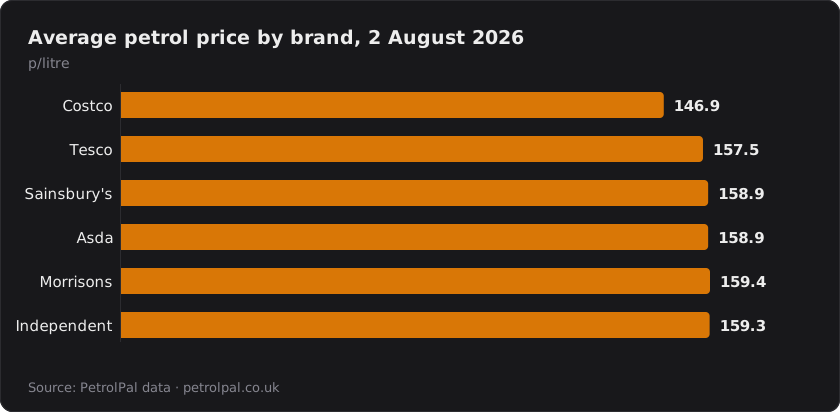
Costco leads at around 146.9p average for petrol, though it requires membership. Among the big supermarkets, Tesco averages 157.5p, with Sainsbury's and Asda close behind at about 158.9p and Morrisons at 159.4p. Independent forecourts average 159.3p, and the overall UK median sits at 159.9p.
The practical takeaway has not changed since the spike began: a supermarket fill on your normal route saves 1 to 3p per litre against the average, and comparing stations before you drive saves considerably more.
What About Premium Fuel?
If you run a performance car on super unleaded, July was more painful still. PetrolPal's live data puts premium petrol at an average of 177.6p per litre, about 17p above standard E10, and premium diesel at 198.0p. The premium-fuel gap widens in absolute terms when base prices rise, so shopping around matters even more for E5 and 99 RON drivers, and availability varies far more from station to station than it does for standard grades.
What to Watch in August 2026
Three things will decide where prices go next:
- The Strait of Hormuz. Shipping flows began recovering at the end of July. If that continues, wholesale prices should stabilise. Renewed attacks would put $100 oil back on the table
- The pass-through lag. Even if crude stays flat, another week or so of July's wholesale rises is still working its way to the forecourt
- Retailer margins. As and when crude falls, the speed of pump-price cuts will show whether competition from price transparency is doing its job
Tip
Tip
Prices are moving quickly right now. Checking live prices before you fill up matters more during a spike than at any other time, because the spread between stations widens when the market is volatile.
What July 2026 Means for Your Fuel Budget
July wiped out June's record falls and put fuel costs back on an upward path, adding around £5 to a typical petrol fill and £7 to a diesel fill in a single month. None of the underlying causes are resolved, so assume volatility through August. The one thing drivers control is where they fill up, and during a spike the gap between the cheapest and most expensive local option is at its widest. Check before you drive, favour supermarket forecourts on your normal routes, and if a motorway journey is coming, plan the fill before the slip road.