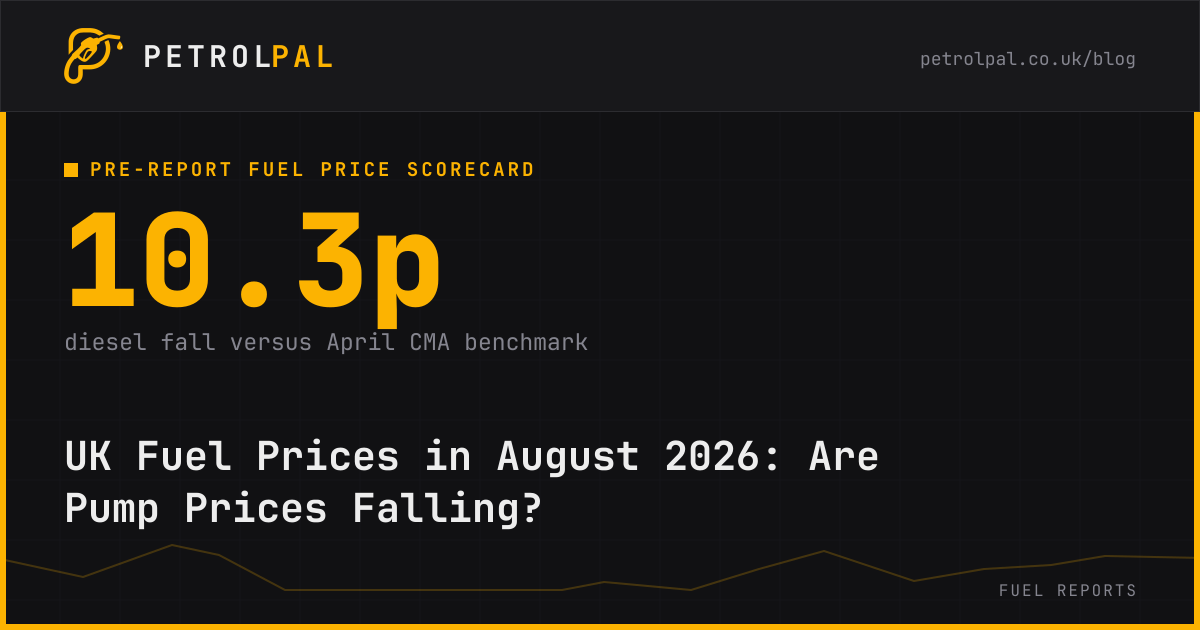
UK petrol averages 160.7p per litre and diesel averages 180.9p on 3 August 2026, according to PetrolPal's live Fuel Finder feed. Diesel is 10.3p below the CMA's April reference point. Petrol is 3.1p higher. The answer differs sharply by fuel.
The CMA's promised August monitoring report has not been published yet. Its road fuel monitoring collection still lists June 2026 as the latest update. So this is a live scorecard, not a summary of an unpublished report. It compares the CMA's June findings with current prices from 8,029 UK stations, then points you to PetrolPal's live fuel map for local checks.
By PetrolPal, using the UK Government Fuel Finder feed and official CMA road-fuel monitoring evidence. Data checked on 3 August 2026.
Has the CMA Published Its August 2026 Fuel Report Yet?
The CMA had published no August monitoring report by 3 August 2026. Its official monitoring collection lists the 1 June update as the newest report. The June document promised another report in August, covering market developments through the end of June, but it gave no publication day.
That timing matters. The report could land on any August date. Publishing imagined findings now would misrepresent the regulator. Instead, this scorecard separates confirmed evidence from open questions. That's the honest line.
The known evidence comes from the CMA's June report. Wholesale costs explained most spring pump-price increases, the regulator found, while average retail margins rose to 11.3p per litre in April from 10.7p across 2025. PetrolPal's fuel price index provides the live benchmark for what happened next.
The awaited evidence covers May and June margins. Those months should show whether retailers cut pump prices quickly when costs eased. The CMA said it expected wholesale reductions to be "rapidly and fully" passed through. That phrase sets a clear standard for the coming report.
According to the CMA's 36-page June monitoring report, average fuel margins reached 11.3p per litre in April 2026, 0.6p above the 2025 average. The August report should reveal whether that increase persisted after supply conditions improved.
Are Wholesale Fuel Cost Falls Reaching UK Pump Prices?
Diesel provides the clearest sign of pass-through. Live diesel at 180.9p per litre is 10.3p below the CMA's 191.2p April reference point. Petrol gives the opposite signal, with live petrol at 160.7p, 3.1p above the CMA's 157.6p April figure (PetrolPal, 2026).
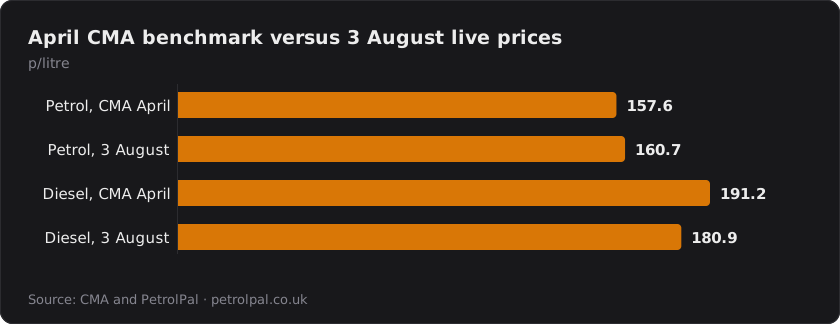
These aren't like-for-like official series. The CMA figure was a weekly UK average for the week beginning 20 April, while PetrolPal's figure is a near-real-time average from Fuel Finder records. Even with that caveat, the comparison shows what drivers see now against the regulator's spring benchmark. What matters at the pump? Direction and scale.
Why would diesel fall while petrol rises? The two fuels have different refining economics, demand patterns and inventories. The CMA found that crude oil and refining spreads together accounted for 31.1p of diesel's 35.3p spring increase. They accounted for 19.9p against petrol's 18.4p increase.
That finding shows why a crude oil price alone can't predict the pump. Refining spreads can move differently for petrol and diesel. Biofuel costs, sterling, duty, VAT and each retailer's buying terms also shape the final number.
The current split suggests pass-through should be judged fuel by fuel. A single headline for "fuel prices" can hide meaningful differences. Diesel's 10.3p decline is material, but petrol drivers haven't received equivalent relief against the April benchmark. PetrolPal's national statistics dashboard lets readers track both series separately.
The CMA reported petrol and diesel at 157.6p and 191.2p in the week beginning 20 April 2026. PetrolPal's 3 August feed shows 160.7p and 180.9p. Diesel is therefore 10.3p lower, while petrol is 3.1p higher (CMA, 2026; PetrolPal, 2026).
What Did the CMA Find About Retail Margins?
Average fuel margins reached 11.3p per litre in April, compared with 10.7p across 2025 (CMA, 2026). That 0.6p increase equals about 33p on a 55-litre fill. It isn't huge alone, but persistent high margins concern the regulator.
The detail matters more than the headline. Supermarket margins were broadly unchanged from March, rising only 0.1p, while non-supermarket margins rose by 1.0p. Across all retailers, eight of 12 recorded lower margins in March, then nine of 12 recorded higher margins in April (CMA June report, 2026).
The CMA didn't find evidence that retailers changed strategy to exploit the spring crisis. Most increases came from wholesale costs, demand and inventory pressure. Still, one concern remained. Passive pricing lets retailers follow nearby rivals instead of cutting first.
What does passive pricing look like for a driver? Prices can remain sticky after costs fall because no large retailer wants to lead a reduction. A rival's price becomes the reference point. That weakens the pressure to pass savings through quickly.
Gross margin percentages add another layer. The CMA found average gross margins fell to 8.0% in March and April, below the historically high 9.3% average for 2025 (CMA June report, 2026). Pence-per-litre margins still rose because pump prices were much higher.
Both measures can be true at once. Retailers may earn a smaller percentage of a larger sale price while keeping more pence per litre. Drivers should watch the cash margin because that amount directly affects each litre's price.
The CMA found April's average margin was 11.3p per litre, while the gross margin rate was 8.0%. The 2025 comparisons were 10.7p and 9.3% respectively (CMA, 2026). Pence margins and percentage margins therefore moved in opposite directions.
Are Supermarkets Passing Savings Through Faster?
Supermarkets are cheaper now by 3.9p per litre for petrol and 5.2p for diesel against branded forecourts, based on PetrolPal's live station data. Supermarket petrol averages 158.3p against 162.2p at branded sites. Diesel averages are 177.0p and 182.2p respectively.
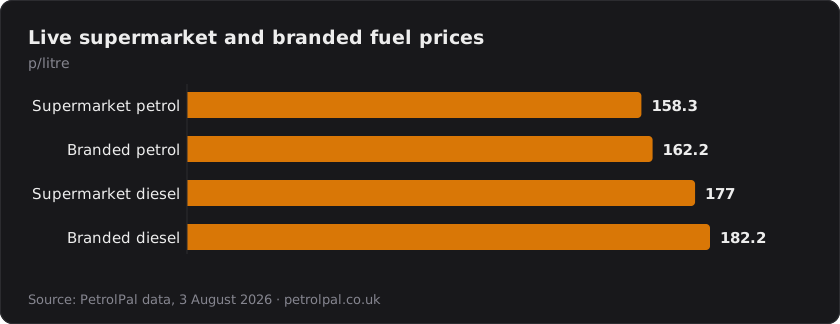
For a 55-litre fill, those gaps equal roughly £2.16 on petrol and £2.86 on diesel. The saving isn't theoretical. It appears across 2,451 supermarket petrol listings and 2,448 supermarket diesel listings in PetrolPal's current data. Yet the nearest supermarket isn't always on your route, so compare the detour before chasing a lower sign price.
The CMA saw the same market structure during spring. Its June report said supermarkets remained materially cheaper than non-supermarket retailers. Motorway petrol averaged about 25p more than supermarket petrol, while the diesel motorway premium returned to around 20p by mid-May.
Does that prove supermarkets pass wholesale falls through faster? Not by itself. Lower prices can reflect higher volumes, different buying contracts and a forecourt's role in attracting grocery customers. The August CMA report needs to compare margins and timing, not only final prices.
PetrolPal's current sample covers 7,813 unleaded prices and 7,892 diesel prices. The median is 159.9p for petrol and 179.9p for diesel. Those medians sit close to the averages, which suggests the national figures aren't being driven only by a few extreme stations.
PetrolPal data shows branded forecourts average 162.2p for petrol and 182.2p for diesel. Supermarkets average 158.3p and 177.0p, producing gaps of 3.9p and 5.2p per litre (PetrolPal, 2026). A 55-litre supermarket fill therefore saves about £2.16 to £2.86. PetrolPal's route planner can help weigh that saving against the extra drive.
What Should Drivers Watch in the CMA's August Update?
The CMA will assess market developments through 30 June 2026, according to its June report. The most important test is whether falling wholesale costs produced timely pump-price cuts. Margin data will show whether retailers kept part of that relief.
First, check May and June pence-per-litre margins against April's 11.3p. A fall toward or below the CMA's 10.7p average for 2025 would support the view that pressure eased. A flat or rising margin would strengthen concerns about weak competition.
Second, compare supermarket and non-supermarket movements. The June report found non-supermarket margins rose 1.0p during April. If that gap widened later, drivers without convenient supermarket access may have received less wholesale relief.
Third, look for evidence of active price competition. Did any retailer cut early and gain sales? Or did most retailers continue to shadow nearby competitors? The CMA's planned autumn market assessment should examine those strategies in more detail.
Fourth, watch Fuel Finder compliance and coverage. The statutory scheme requires traders to submit a changed price within 30 minutes, according to the CMA's monitoring collection. Better coverage gives drivers a practical way to reward cheaper stations.
Finally, don't confuse a national average with your local market. PetrolPal's live data shows a 3.9p petrol gap between supermarket and branded averages. Your town may differ. Check PetrolPal's regional fuel price view before a large fill. One number can't describe every local market.
The CMA's August report is expected to cover two months beyond April and test full pass-through through June. Its benchmark is demanding: wholesale reductions should reach pump prices rapidly and fully (CMA, 2026). May and June margin data will decide whether retailers met it.
PetrolPal currently tracks 8,029 UK stations, while its detailed fuel dataset contains 7,813 unleaded and 7,892 diesel prices (PetrolPal, 2026). These answers use that live evidence alongside the CMA's latest published monitoring report and PetrolPal's fuel comparison tools.
What Is the Verdict Before the Report Lands?
The live evidence gives a mixed answer. Diesel at 180.9p per litre is 10.3p below the CMA's April benchmark. Petrol at 160.7p is 3.1p above its benchmark (PetrolPal, 2026). Wholesale relief appears more visible in diesel than petrol, and that difference deserves more attention than a blended headline.
The CMA's August report must settle the harder question. Did margins fall when wholesale pressure eased, or did pump prices remain sticky? April's 11.3p margin and persistent passive pricing leave room for concern.
Drivers don't need to wait for the regulator to act. Current PetrolPal data shows supermarkets are cheaper by 3.9p on petrol and 5.2p on diesel. Compare nearby prices on the PetrolPal map, especially before buying 50 litres or more. It takes moments. That short check can turn market transparency into an immediate saving.