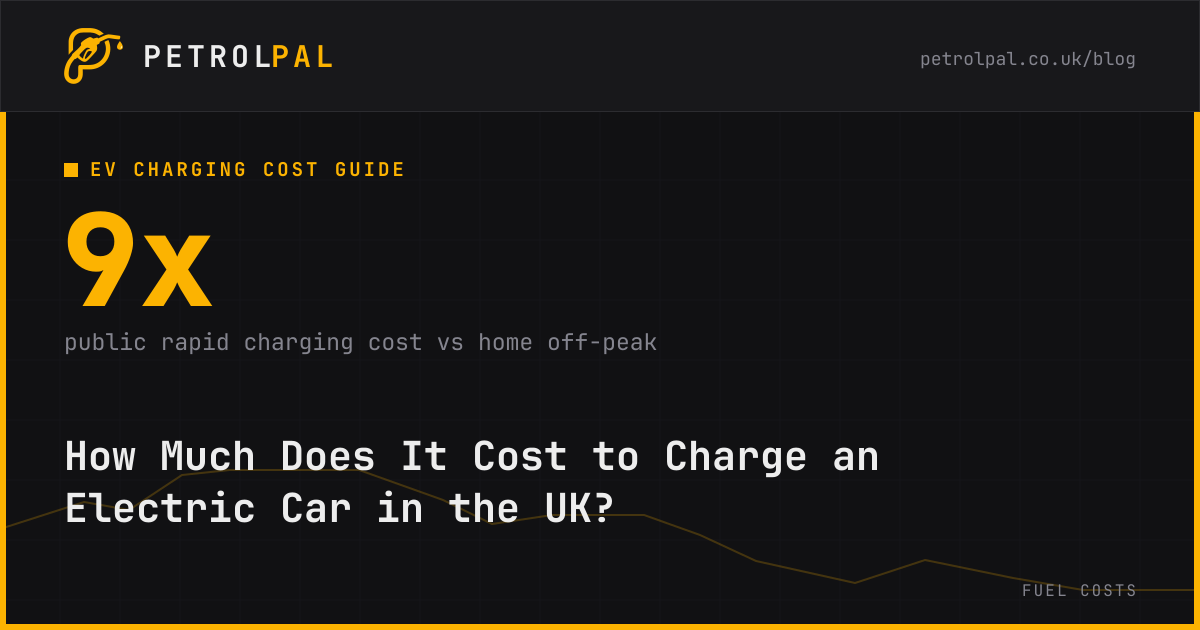
Charging a 60kWh electric car costs about £4.80 at an 8p off-peak home rate, £15.67 at Ofgem's current 26.11p cap-rate average, or £46.20 at the 77p public rapid average. Where and when you plug in can therefore change the same battery's energy cost by more than £40.
For an average-efficiency EV, Zapmap puts public charging at 16p per mile on slower chargers and 23p on rapid chargers. Home charging is usually much cheaper. PetrolPal's 18 September fuel snapshot put petrol at 171.6p per litre, equal to about 19.5p per mile in a 40 MPG car. Source
What does home EV charging cost in September 2026?
Ofgem's average electricity unit rate for a standard variable tariff paid by Direct Debit is 26.11p per kWh from 1 July through 30 September 2026. It includes 5% VAT and covers England, Scotland and Wales. The actual rate varies by region, payment method and meter. The separate average electricity standing charge is 57.19p per day, but most households already pay it before buying an EV. Source
At 26.11p per kWh, 60kWh of energy costs £15.67 before charging losses. Treat this as a tariff comparison, not a promised bill for adding 60kWh to the battery.
A dedicated EV tariff can cut the unit price sharply during a fixed overnight window. Intelligent Octopus Go advertises 8p per kWh from 11:30pm to 5:30am for compatible cars or chargers. On that rate, 60kWh costs £4.80 before losses. Eligibility, daytime prices and standing charges still matter, so compare your complete household bill. Source
Most drivers add only the energy used that day rather than charging an empty battery. The car, charger and electricity supply determine the available speed, so check their specifications before estimating a charging time.
How much does public EV charging cost now?
Zapmap's August 2026 Price Index gives a weighted pay-as-you-go average of 54p per kWh for Standard and Standard Plus chargers from 3kW to 49kW. The average is 77p per kWh for Rapid and Ultra-rapid chargers rated at 50kW or more. Zapmap says its index uses data covering about 75% of UK public chargers and two million charging sessions each month. Source
Those averages make a 60kWh energy purchase cost £32.40 on the slower public group or £46.20 on the rapid group. You rarely arrive with an empty battery, so a 20% to 80% stop adds 36kWh. That costs about £19.44 at 54p or £27.72 at 77p.
The averages do not mean every network charges the same price. Zapmap reports examples below the rapid average, including Believ at 66p, Sainsbury's Smart Charge at 72p, and open Tesla Supercharger sites averaging 63p for non-Tesla drivers. Tesla drivers averaged 46p across the full Supercharger network. Prices, access rules and memberships can change, so check the operator before starting a session. Source
Some sites also charge for parking, overstaying or remaining connected after charging ends. A low pence-per-kWh price can lose its advantage if the car park adds a large fee. Check the operator app, charger screen and parking signs separately.
Is home charging cheaper per mile than petrol?
Yes, for most drivers with reliable home access. Using an illustrative EV efficiency of 3.5 miles per kWh, an 8p home rate costs about 2.3p per mile. The 26.11p capped-rate average costs about 7.5p per mile before charging losses. The 77p rapid average costs about 22p per mile on the same efficiency assumption.
Zapmap uses its own average-EV assumption and reports 16p per mile for the 54p public average and 23p per mile for the 77p rapid average. Its driver profiles use an 8.6p home rate. It estimates an annual saving of £1,030 for a mostly home-charging household and £590 for a mixed home-and-public household against equivalent petrol use. Source
PetrolPal's live UK snapshot on 18 September showed regular petrol at 171.6p per litre. A 40 MPG petrol car costs about 19.5p per mile at that price. Source
At 7,000 miles a year, that petrol example costs about £1,365. Home charging at 8p per kWh and 3.5 miles per kWh costs about £160 before losses, a difference of roughly £1,205. This is an energy comparison, not a total ownership calculation. Purchase price, insurance, depreciation, servicing, finance and tax can outweigh energy savings.
Efficiency changes the result. A large EV returning 2.5 miles per kWh costs 30.8p per mile at the 77p rapid average. An efficient car returning 4 miles per kWh costs 19.3p. Cold weather, high speed, roof loads, towing and cabin heating can all increase energy use.
How large is the UK public charging network?
The Department for Transport recorded 121,171 public EV chargers on 1 July 2026. Of these, 28,887 were rated rapid or above at 50kW or more. Standard chargers from 3kW to below 8kW made up 49% of the network, while Standard Plus chargers made up 27%. Rapid and Ultra-rapid each accounted for 12%. Source
The measure changed in January 2026. DfT now reports individual public EV chargers, also called EVSE, rather than the older charging-device measure. Do not compare the two series as if they count the same unit.
Network coverage also depends on location and speed, not only the national total. DfT classed 52% of chargers as destination charging, 33% as on-street, 11% as en-route and 4% as other. London had 345.1 public chargers per 100,000 people but only 27.9 rapid-or-faster chargers per 100,000. Scotland had 231.6 total and 59.1 rapid-or-faster chargers per 100,000. Source
Use PetrolPal's EV charger map to check connector type, power and availability near your route. Confirm the operator's current price before travelling because charger-map records and tariffs can update at different times.
Which home and workplace charger grants remain open?
The Office for Zero Emission Vehicles extended five grant schemes until 31 March 2027. From 1 April 2026, eligible residents and landlords can receive up to £500 per socket, increased from £350. Residents can apply for one socket, while eligible landlords can apply for up to 200 sockets across their sites. Source
The home schemes cover eligible renters and flat owners, residential landlords, and households with on-street parking. Each scheme has detailed conditions. For example, renters and flat owners generally need private off-street parking. The on-street scheme needs an approved permanent cross-pavement solution.
The Workplace Charging Scheme now offers eligible organisations up to £500 per socket for installations completed from 1 April 2026. Applicants can claim for up to 40 sockets across their sites. State-funded education institutions can apply for up to £2,000 per socket, also across up to 40 sockets. Source
Do not arrange installation before checking the current process. GOV.UK says customers must receive eligibility confirmation before the chargepoint is installed under the applicable scheme.
Do electric cars pay road tax in 2026?
Yes. Electric and zero-emission vehicles have paid Vehicle Excise Duty since 1 April 2025. For rates from 1 April 2026 to 31 March 2027, an electric car registered on or after 1 April 2025 pays £10 in its first year and then the £200 standard annual rate. Cars registered from 1 April 2017 through 31 March 2025 pay £200. Source
Electric cars registered from 1 March 2001 through 31 March 2017 pay £20. A zero-emission car registered on or after 1 April 2025 with a list price above £50,000 can also face the expensive car supplement for five years, starting with its second tax year.
Tax no longer creates the old zero-VED running-cost advantage. Energy can still cost much less than petrol when most charging happens at home, but rapid-only drivers may pay similar or higher energy costs per mile.
How can you reduce EV charging costs?
First, measure your real efficiency from the car's trip computer over several weeks. Divide the tariff's pence-per-kWh rate by miles per kWh to estimate pence per mile. Then compare the estimate with actual electricity bills, which include charging losses.
Second, schedule routine charging inside the cheapest tariff window. Set both the car and charger carefully because conflicting schedules can prevent charging. Check whether the tariff can move sessions outside the advertised window and whether daytime electricity becomes more expensive.
Third, use rapid charging for time-sensitive journeys rather than every refill. A slower destination charger can cost less while the car is already parked. Free workplace, hotel or retailer charging can help, but confirm parking and access conditions.
Fourth, compare memberships only against your expected monthly use. A £10 monthly plan that saves 10p per kWh needs 100kWh of charging before it breaks even. Cancel it when your travel pattern changes.
Finally, plan the complete stop. PetrolPal's route planner can help you identify chargers along a journey. Check the network app for price, connector status and access, then keep a backup stop within the car's safe range.